Posts

Golgotha (Holy Week)

Image
Read: Mark 15:22-24 Reflect: Golgotha - the place of the skull - would have been a place deeply linked to death. We don’t know whether it got the name from its appearance or whether it was a place where people were regularly executed. We do know, though, that it is a place that carries great sadness, grief, loss, shame and death.  Jesus does not shy away from this place. He does not choose to run and hide, to send for angels or to be sacrificed in a place more fitting for a king. No. His act of sacrifice happens in a place of death and sorrow. This act reminds us that Jesus finds us in our most sorry state, wherever that may be. Jesus does not shy away from our guilt, our pain, our suffering, our shame and our grief. He comes and finds us there and, ultimately, redeems it to the glory of His name. As with His birth, when He chose to enter our world in the filth of a lowly stable (where He was also offered myrrh), He chooses an impure and sorrowful place to save the world. Respond: ...
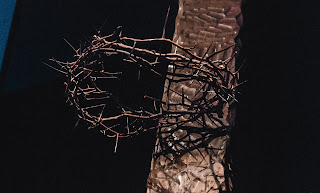

Mocking (Holy Week)

Image
Read: Mark 15:16-20 Reflect: Two of the scariest verses in the Bible, for me, are verses 17 and 18 in today’s passage: ‘They put a purple robe on him, then twisted together a crown of thorns and set it on him. And they began to call out to him, “Hail, king of the Jews!”’ It’s scary because of the accuracy of the soldiers’ words with their hearts in completely the wrong place. They clothed Jesus in a purple robe (a sign of royalty, which He is) but they did it mockingly. They crowned Him as Lord, but with a crown of thorns. They hailed Him as King, but sarcastically. In one sense they said the right words and did the right things, but not because they believed them to be true or significant. We face falling in the same trap. We may say the right things - “Hail Jesus the King!” - , crown Him as Lord - but not of my heart -  or bring expensive sacrifices and still miss the mark. May we recognise Jesus as the true King of all, and may we respond accordingly. Respond: Lord Jesus, thank ...

Exchange (Holy Week)

Image
Read: Mark 15:6-11 Reflect: The story of Barabbas and Jesus is a really clear and visual reminder of what exactly Jesus did for every one of us. Barabbas was guilty of his crimes: insurrection and murder. His execution was justified according to Roman law. But Jesus is taken to the cross in his place. Even though Jesus was innocent, He took on the suffering and shame of the cross in Barabbas’s place. And in ours. Isaiah prophesied that this would happen: ‘But he was pierced for our transgressions, he was crushed for our iniquities; the punishment that brought us peace was on him, and by his wounds we are healed. We all, like sheep, have gone astray, each of us has turned to our own way; and the Lord has laid on him the iniquity of us all.’ (Isaiah 53:5-6 - NIV). Respond: Lord Jesus, thank you for your great sacrifice. Thank you that you took on the punishment for my sins. Thank you for paying the price that I may be blameless and pure before the Father. Please help me remember your sac...

Divine

Image
Read: Mark 14:60-62 Reflect: In one of the few times Jesus spoke after His arrest He announces Himself to be the Son of God. That is no little thing. Ironically, this truth is one of the pieces of “evidence” the high priest uses to justify Christ’s crucifixion. Essentially Jesus is crucified for speaking the truth.  We know from yesterday’s passage that Jesus was truly human. Today we find that He was also truly divine: He was God. This was necessary to bridge the gap between us (humans) and God (divine) because we (humans) were unable to bridge the gap or give anywhere near to sufficient sacrifice. Without Jesus there would still be a great divide between us, but because of Jesus we can be reunited with God Himself. Respond: Lord Jesus, thank you for bridging the gap between us and God. Thank you for stepping into this world, away from your throne in heaven, to not just be with us, but to bring us to you. Amen. Remind: ”Not only do we not know God except through Jesus Christ; We d...

Human

Image
Read: Mark 14:32-34 Reflect: I find it encouraging to read how Jesus said He felt overwhelmed. We might think it strange that Jesus (being truly God) would feel overwhelmed, but this speaks to the very human nature of Jesus. He wasn’t just a God pretending to be human. He was well and truly fully human. He felt the things we feel. He experienced the world through the senses we have. He felt pain. He felt distressed. He felt the joy of community and the sadness of betrayal. That’s why we can take all our feelings and experiences to Him, knowing that He understands. Hebrews 4:15 explains it beautifully: ‘For we do not have a high priest who is unable to sympathize with our weaknesses, but we have one who has been tempted in every way, just as we are-yet he did not sin.’ Respond: Lord Jesus, thank you that you were truly human. Thank you that you suffered like we suffer. Thank you for stepping into our world and not just skimming over it like a false god might. Amen. Remind: “Nothing can ...

Wine

Image
Read: Mark 14:23-24 Reflect: In the Biblical times a covenant would be sealed (made official and binding) in blood. Jesus makes another link with Passover where the blood of a sacrificial lamb saved the Israelites from death in Egypt. Jesus takes this one step further by making the covenant not just binding to Jews, but to all who would receive it. This, of course, is a binding covenant that no one and nothing can break. One sacrifice made for the forgiveness of many sins. Respond: Lord Jesus, thank you for your sacrifice. Thank you that nothing can take me from the reach of your grace and forgiveness. May my life testify to the freedom I find in your covenant. Amen. Remind: “Because God is the living God, He can hear; because He is a loving God, He will hear; because He is our covenant God, He has bound Himself to hear.” ~Charles Spurgeon~ Photo by   Stephen Rheeder   on   Unsplash

Bread

Image
Read: Mark 14:22 Reflect: The Passover rites were observed by Jewish people since their rescue from Egypt (Exodus 12). Jesus takes the bread and changes its meaning to reflect the salvation work He has come to do. By offering the disciples bread Jesus gives them (and us) something to remember and celebrate His sacrifice by. Though they did not know it at the time Christ’s body would be broken like the bread was broken, and offered to all who would accept it. And like bread we need to accept it and take it up daily (Matthew 6:11). Respond: Lord Jesus, thank you that your body was broken for me. I accept your offer of salvation again. Amen. Remind: ”Bread of Life? Jesus lived up to the title. But an unopened loaf does a person no good. Have you received the bread? Have you received God's forgiveness?” ~Max Lucado~ Photo by   Maria Ionova   on   Unsplash